
Pathemata Mathemata
The Neccessity of Suffering.

The time is 4 a.m and I want you to wake up to this writing - before you continue reading, play this song - keep it on repeat throughout the duration of your reading this piece. I want you to experience a state of flow, I use to optimise all of my reading experiences.
Now back to my thoughts. This writing is inspired by a perspective I first stumbled upon during a season when I was very invested in Greek mythology and plays.
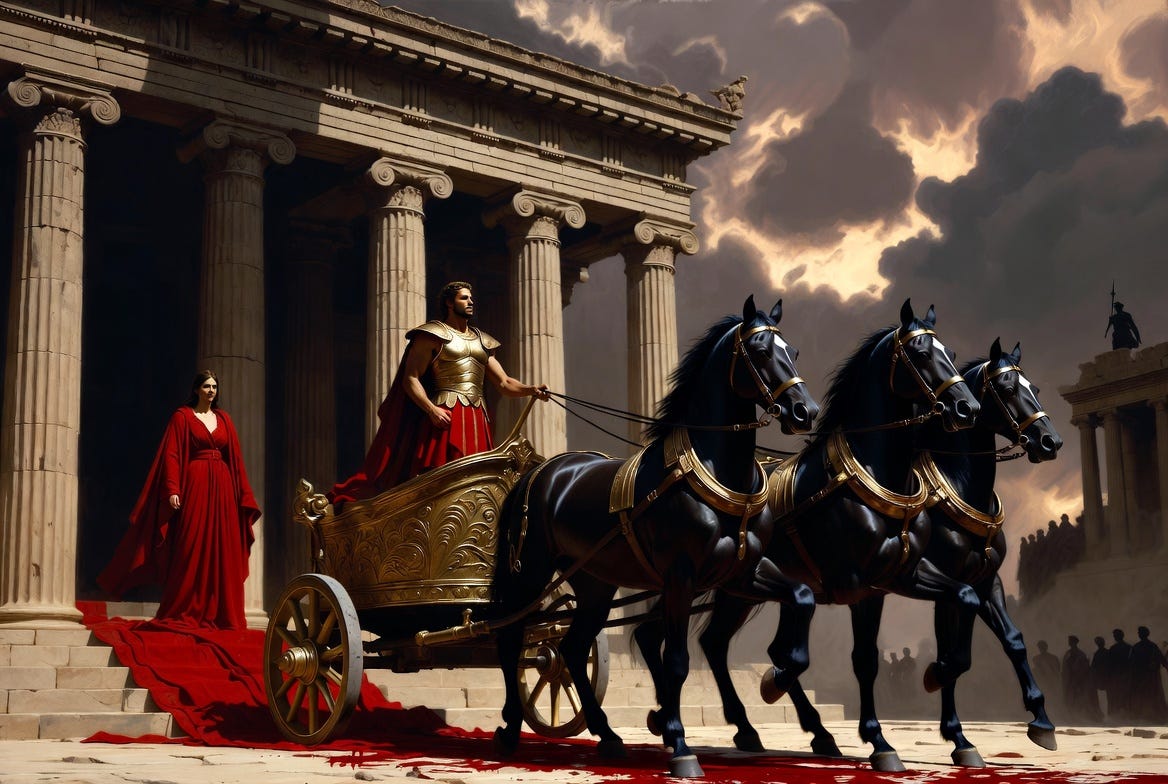
There is a popular one, Agamemnon, which is the first play in the series Oresteia, which tells a story of victory, guilt and revenge - it birthed the phrase “Pathemata Mathemata“.
Agamemnon’s family was cursed because his father, Atreus, committed terrible crimes against his brother, Agamemnon’s uncle and because of this curse, when the Greeks prepared to sail against Troy - the gods withheld the winds and to appease the gods, Agamemnon had to sacrifice his own daughter. After 10 years of war, they won the war and Agamemnon returned home with his fleet and spoils of war.
The sacrifice of his daughter earned him undying hatred from his wife, Clytemnestra. As the city celebrated the victory, Cly plotted revenge. She welcomed him with devotion, walked him into their chambers before driving a sword through his heart.
The war at Troy was purchased by the blood of Agamemnon’s daughter. The victory of Troy also required a price, his life. His death also incurred grief upon Clytemnestra.

Pathemata Mathemata; wisdom only comes through suffering.
I am only 32, and if there is any consistent theme I have learned about life, it is the fact that people rarely learn from comfort, success, or power, but from the wounds left by their own actions and the consequences from which they cannot escape. True lessons, undeniable depths of wisdom come from suffering, just as growth. To know is to suffer because knowledge is a burden.
Have you seen how stupid, clueless people lead their lives? Have you seen how they engage in conversations or obvious societal maladies? WITHOUT WORRY. If you want to know, you have to suffer. When you know, you have to be at peace with consistent suffering. Suffering inspires growth.
The ancient Greeks understood something about human nature that we still struggle to accept. They captured it in two words: Pathemata Mathemata.
When we look at the story of Agamemnon, I pose to you a question:
Who is the villain?
The father who sacrificed his daughter?
The mother who murdered her husband?
You see, it is not that simple because in the end, everyone has a justification or can provide reasons for their actions. The most consistent theme here is the suffering inflicted on everyone, the knowledge and the painful stripping of illusions that suffering orchestrated.
Agamemnon learns that political necessity does not erase moral responsibility. Clytemnestra learns that vengeance cannot resurrect the dead, and their descendants will learn that every act of revenge creates a fresh claim for revenge. Each generation acquires wisdom only after paying a price.
There is so much “basic information“ we know as a society - if information alone was superior, we would not be having the regularities of certain auto-inflicted chaos.
Do we not know that smoking is dangerous? We do, yet, 15 billion cigarettes are consumed per day. We know debt can become a trap. We know arrogance destroys careers, relationships, and institutions. We know that power can corrupt. We know wars create unintended consequences - we had 2 world wars, multiple invasions and occupations, leaving millions dead, yet societies repeat these “mistakes” with astonishing regularity.
Knowledge, or a lack of knowledge, is not the problem. So I dare say, knowledge isn’t power. Suffering is power.
A young entrepreneur hears stories about reckless expansion and founder regrets - he only nods and is the least likely to apply. Then comes the failed venture that burns through savings and confidence. A nation ignores historical lessons until another crisis forces them back into memory. In each case, knowledge existed beforehand. Wisdom arrived afterwards.
The Greeks understood this distinction. They recognised that there are truths the intellect can grasp and truths the soul can only acquire through experience.
Which is what brings me back to you - why I am writing this piece to you.
You need to realise what the Greeks knew, what I came to accept over a decade ago - You need to suffer before you break through new levels of depth, wisdom or capacity. If you are okay with mediocrity or the comfort of your safety nets, this is not for you - the suffering will still come, though, because to be human is to suffer.
The lesson here is not merely to suffer. Suffering alone teaches nothing. Many people endure hardship and emerge only bitter. The goal is to convert suffering into understanding - to use suffering to break into new levels of depth. This is why every single person I look up to LOVES to fail. Failure has been villainised societally, in ignorance. Failure is beautiful. It is a catalyst that shows you what will not work, what needs to change, what inadequacies to optimise, and how to be better. How you think about suffering and failure needs to change.
The House of Atreus, Agammenon’s home, paid its tuition in blood. Most of us will not face tragedies of such magnitude. Yet the principle remains the same. Every setback contains a question: What is this trying to teach me?
The answer may not come immediately. It may take years, but the deepest lessons are rarely the ones we are told. They are the ones we survive. This is why you need to constantly be on alert, so you can catch on in your 40s what that lesson is, and you can optimise as soon as you can, rather than for it to be in retrospect in our 80s.
Who knows? Perhaps what we now define as maturity is nothing more than a growing collection of lessons we once resisted and later learned the hard way.
The Greeks had a name for that process. Pathemata Mathemata. Through suffering comes learning. Through wounds comes wisdom. Through pain comes the possibility of becoming someone who finally sees clearly.
My friends, to suffer is to become.